04
GHK-Cu, GHK and the scalp mixture
The copper belongs in the chemical name. The other active ingredient belongs in the account of the hair trial. Both are easy to lose along the way.
A plasma peptide becomes a skin ingredient
GHK began in an unexpected place for a familiar skin-care ingredient: human plasma and experiments with aged liver tissue. Loren Pickart isolated it in 1973 as a factor associated with a more youthful pattern of protein synthesis in that tissue. Later work explored the copper-bound form, GHK-Cu, in tissue repair and skin.
I relish the liver experiment at the beginning of this skin-care story. It gives the subject a history more interesting than a cream’s implied promise of youth. GHK consists of three amino acids; adding bound copper produces GHK-Cu. Papers concerning either form deserve their actual chemical name.
The skin-regeneration review describes stimulation of collagen and other supporting material in experimental work, alongside small human topical studies. Collagen helps give skin its structure. A finding about its production is one part of a skin outcome.
The scalp mixture
The controlled hair trial enrolled 45 men with androgenetic alopecia, the common inherited pattern of hair loss. Over six months, groups receiving GHK combined with 5-aminolevulinic acid had greater increases in hair count than placebo. No adverse events were reported in any group during the trial.
This is the study that opens the review’s front page. I regard its mixture as the central fact, rather than a nuisance to remove from the summary. There was no GHK-alone comparison and no test of GHK-Cu alone. The encouraging result therefore travels with the combined formulation.
A trial separating the ingredients would resolve more than another description of the same mixture’s success. It could establish which ingredient contributed, or whether the combination mattered.
Procollagen comparisons
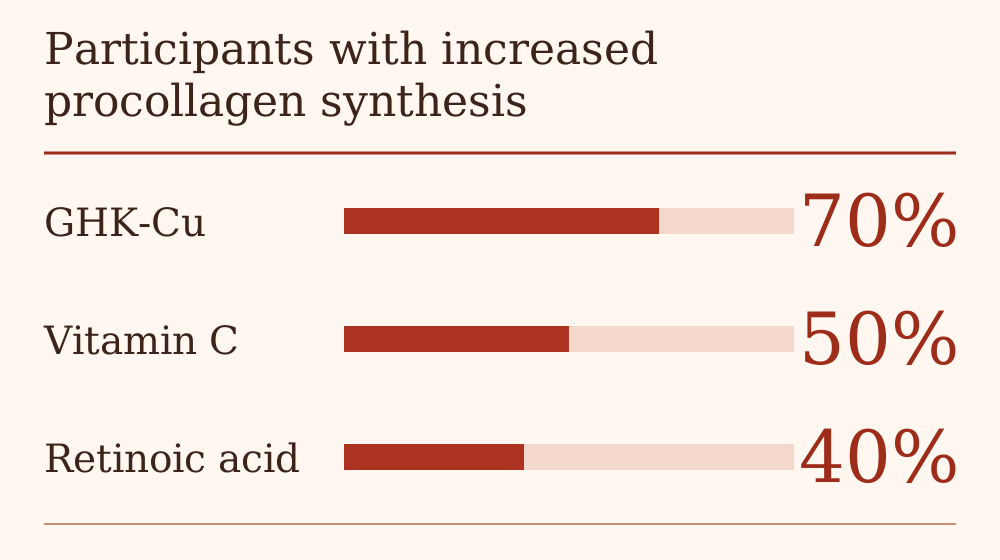
A review of topical GHK research reports increased procollagen synthesis in 70% of GHK-Cu-treated subjects, compared with 50% for vitamin C and 40% for retinoic acid. Procollagen is material that cells process into collagen.
Those percentages count people with an increase. They do not describe the amount of extra collagen, the percentage of wrinkles removed or the probability that any skin product will work. That distinction gives these modest-looking comparisons their proper scale.
A larger, well-controlled topical trial would carry more weight than another expansive claim about rejuvenation. The existing human studies remain small, and the earlier skin review also combines clinical observations with laboratory findings.
Copper transport; GHK expression
The topical review identifies poor passage of GHK through the outer skin layer as a delivery problem. Altering a formulation or preparing the skin changes the experiment. A separate study using human skin outside the body measured copper passing through and remaining in different skin layers after GHK-Cu application. It measured copper transport, without measuring wrinkle improvement in living participants.
The gene-expression analysis concerns changes in how actively cells use genetic instructions after GHK exposure. Its counted changes used a threshold of at least 50% more or less expression. The DNA sequence was not rewritten.
I’d follow those cell-expression patterns into tissue before treating them as a cosmetic finding. They propose work to investigate in tissue and in people. They leave considerable distance between a striking database pattern and a dependable cosmetic result.
Topical cosmetics; systemic exposure
Copper Tripeptide-1 is an ingredient in topical cosmetics. GHK-Cu has no approved medical treatment use, and injectable or systemic use lacks validated human pharmacokinetic evidence about where it goes and how long it remains. The topical literature cannot establish injection safety.
Community accounts describe firmer or more hydrated skin, softer fine lines and less hair shedding. Other accounts describe redness, dryness, irritation, breakouts or uneven pigmentation. These are anecdotal accounts of what people noticed, without controlled clinical evidence of cause or frequency. They cannot apportion an effect among products used together.
The formulation review also makes stability part of the question. A product that loses intact copper-peptide complex presents different contents from the material originally studied. Some of the skin results encourage me. Extending that confidence to every form or route would require much more evidence.